




Video modal

Practical Solutions for Clinical Endpoint-Driven Studies
July 28, 2026
Independent Endpoint Adjudication Committees (EACs) or Clinical Events Committees (CECs) are critical to ensure consistent, protocol-defined classification of clinical events in endpoint-driven trials.
Depending on the study, adjudicated events may include:
- cardiovascular outcomes,
- disease progression,
- recurrence of disease,
- hospitalizations,
- safety events or device-related events.
Drawing on more than 25 years of clinical research experience supporting endpoint-driven clinical trials, we've learned that successful endpoint adjudication depends not only on expert medical review, but also on well-coordinated operational processes that support every stage of the review.
Adjudication is more than a single clinical review. It requires complete case packages, trained reviewers, independent assessments, timely disagreement resolution and traceable final decisions.
When cases are managed across emails, spreadsheets and disconnected repositories, teams lose visibility, and timelines are more likely to slip while documentation becomes more complex to reconstruct.
A structured e-adjudication workflow brings the process together, from event identification to final adjudication and classification so teams can focus on review quality.
How Endpoint Committee Management Becomes Complex
Endpoint adjudication requires structure because the review path is not always linear. Events need to be identified, documented, packaged, assigned, reviewed, discussed, escalated and finalized before they can be used confidently in the study analysis.
Several key operational areas require ongoing management throughout the adjudication process. The table below highlights these areas and the considerations associated with each.
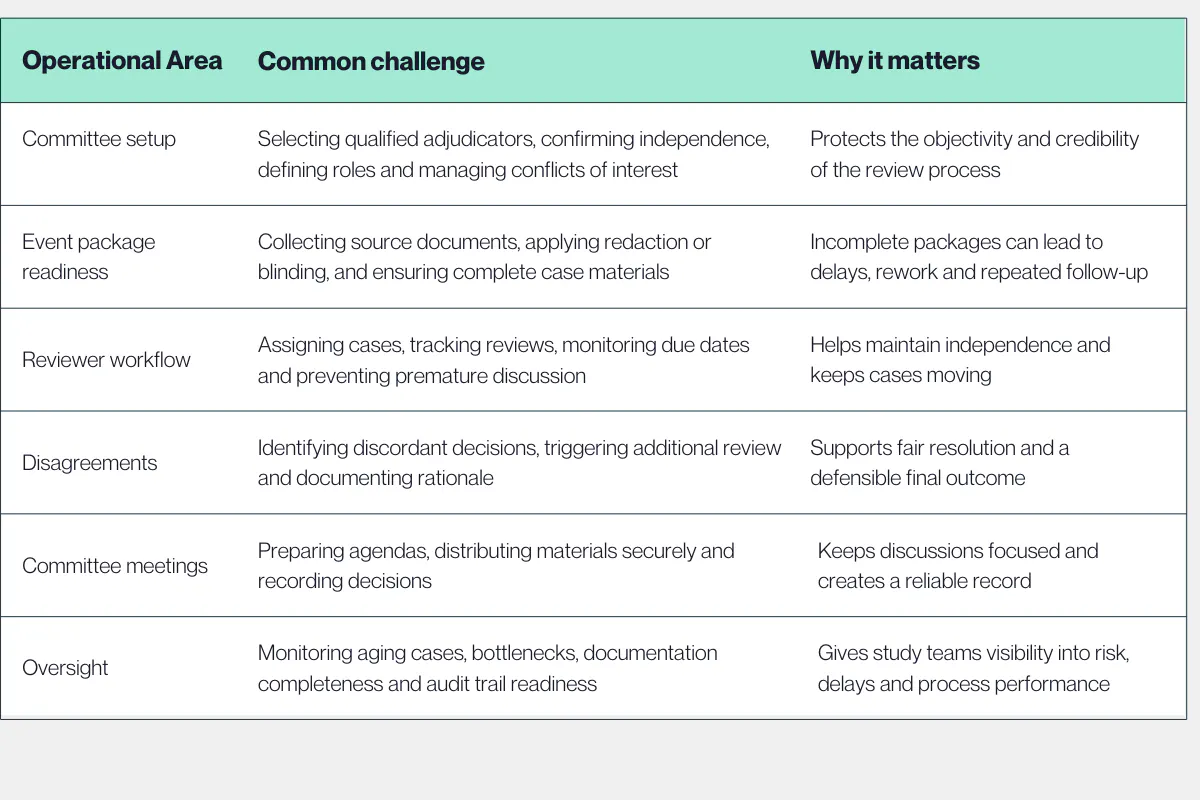
This is where a structured workflow becomes essential: it helps ensure that each event moves through a clear, traceable and controlled process from identification to final adjudication.
What a Structured e-Adjudication Workflow Should Support
A structured e-adjudication workflow should support more than document exchange. It should help study teams manage the operational path from event identification to final endpoint decision.
Key elements include:
- clear committee roles and reviewer assignments;
- documented training on the adjudication charter, endpoint definitions and decision rules;
- controlled case package preparation and completeness checks;
- secure, role-based access to supporting documentation;
- independent reviewer assessment capture and blinded review, as applicable;
- real-time visibility into pending, overdue and escalated cases;
- predefined discordance and committee-resolution workflows;
- meeting preparation, decision documentation and action tracking;
- complete, accessible audit trails;
- oversight of documentation completeness and inspection readiness.
The result is less manual reconciliation, clearer accountability and a more consistent, transparent process for sponsors, CROs, committee members and study teams.
A Practical EAC/CEC Management Checklist
The following checklist (Download as PDF) can help study teams assess whether their endpoint adjudication process is structured, traceable and manageable.
1. Committee setup
- Are roles, responsibilities, independence and conflicts of interest documented?
- Are the charter, endpoint definitions, blinding model and reviewer training finalized?
2. Event package readiness
- Are required source documents and package-completeness criteria defined by event type?
- Are redaction, blinding, missing-document follow-up and readiness timestamps controlled?
3. Reviewer workflow
- Are cases assigned according to the charter, with independent review preserved?
- Are due dates, status and escalation tracked by case, event type and reviewer?
4. Disagreement resolution
- Are discordant decisions identified and routed through a predefined resolution pathway?
- Are final classifications, rationales and the full decision path traceable?
5. Committee meetings
- Are agendas limited to unresolved or escalated cases, with secure advance distribution?
- Are decisions, rationales, minutes and follow-up actions documented and tracked?
6. Oversight and inspection readiness
- Are aging cases, bottlenecks and documentation completeness visible by reviewer, site, event type and status?
- Can the team access a complete audit trail and reconstruct every final endpoint decision?
From Manual Coordination to Structured Oversight
Clinical judgment remains central to adjudication, but weak operational workflows can delay even experienced committees.
A structured approach can help teams:
- maintain case-level visibility;
- reduce manual follow-up and reconciliation;
- support consistency across reviewers and events;
- document decisions and rationale more clearly;
- strengthen audit and inspection readiness;
- reduce administrative burden for sponsors, CROs and committee members.
The value of e-adjudication lies in the traceable process around each decision, who reviewed what, when, against which criteria and how the final classification was reached.
Supporting Endpoint Workflows
A structured e-adjudication workflow helps transform endpoint review into a consistent, traceable process, giving study teams greater visibility from event identification through final endpoint classification.
To address these operational needs, Seriant developed MeTRO e-Adjudication, a validated solution designed with input from experienced clinical research professionals. It supports the secure review of event dossiers, reviewer assignment, training, independent assessments, disagreement management, status tracking, and fully traceable documentation.
MeTRO e-Adjudication can be deployed as a standalone module or combined with Seriant’s broader EAC/CEC coordination and oversight services. It is part of the validated MeTRO Clinical Trials Platform, which offers a suite of structured modules supporting study execution across a range of clinical studies.
To discuss your electronic adjudication or EAC/CEC coordination needs, contact Seriant at contact@seriant.org.